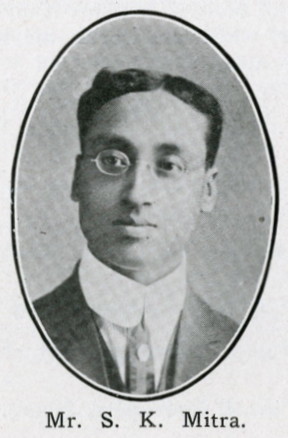
Sisir Kumar Mitra
Born 13 February 1890 · West Bengal
Died 13 August 1963
Founded the Radio Research Board of India in 1942 to advance ionospheric and radio wave research.
🔔 Add birthday reminderSisir Kumar Mitra MBE, FNI, FASB, FIAS, FRS was an Indian physicist.
✨ A detail that surprised us
Mitra established the first ionospheric field station in India at Haringhata in 1950, decades before ionospheric research became widespread in the country.
1. 🌟 In 1890, Sisir Kumar Mitra was born in Konnagar, Bengal Presidency, into a family blending orthodox Hindu and progressive Brahmo Samaj traditions, setting the stage for his scientific curiosity.
2. By 1916, Mitra began research under Nobel laureate C.V. Raman at Presidency College, Kolkata, completing his D.Sc. in just three years by 1919 through experiments on light diffraction and interference.
3. ✈️ As a child in Bhagalpur, around 1897, Mitra’s fascination with atmospheric science was sparked by hearing about Ramchandra Chatterjee’s 1889 solo balloon flight, India’s earliest aeronautical feat.
4. In 1920, Mitra moved to Paris to work under Charles Fabry at the Sorbonne, advancing his studies on copper spectrum wavelengths between 2000-2300 Å and earning a doctorate.
5. 📡 In 1950, he established India’s first ionospheric field station at Haringhata near Kolkata, pioneering ionospheric research that supported emerging wireless communication technologies.
6. His 1947 treatise, The Upper Atmosphere, became internationally recognized, translated into multiple languages and serving as a cornerstone in radio physics and atmospheric studies.
7. 🏅 Mitra was elected Fellow of the Royal Society in 1958 and received the Padma Bhushan in 1962, affirming his scientific stature in pre- and post-independence India.
8. ❓ How did Mitra’s early exposure to balloon flight stories and Brahmo Samaj progressive ideals shape his unique approach to exploring Earth’s upper atmosphere and radio physics?
Awards & Honours
- 🏅Padma Bhushan
🔍 One thing most people don't know

At age six or seven, Mitra’s fascination with atmospheric science began after hearing about Ramchandra Chatterjee’s 1889 solo balloon flight, the first by an Indian aeronaut. This childhood curiosity steered his scientific focus decades later.
🖼️ Through the Years
📅 The Journey
🗝️ Discoveries
🎥 Speeches & Recordings
🎥 Know a speech or documentary about Sisir Kumar Mitra?
📖 Curated Sources
🌱 What changed because of them
Mitra’s foundation of ionospheric studies in India led to the creation of institutional research programs in atmospheric physics, notably at Calcutta University and later at dedicated research centers. His work laid the groundwork for India’s advances in radio communication and space science. By introducing courses on wireless technology and setting up field stations, he helped position India on the global map of atmospheric physics research.
💬 Social Buzz
🐦
What are people saying about Sisir Kumar Mitra?
Found a post from a historian, journalist or notable voice? Share it here and help tell their story. 🇮🇳

