S. R. Srinivasa Varadhan
Born 2 January 1940 · Tamil Nadu
Created the unified theory of large deviations in probability theory.
🔔 Add birthday reminderSathamangalam Ranga Iyengar Srinivasa Varadhan, is an Indian American mathematician and statistician. He is known for his fundamental contributions to probability theory and in particular for creating a unified theory of large deviations. He is regarded as one of the fundamental contributors to the theory of diffusion processes with an orientation towards the refinement and further development of Itô’s stochastic calculus. In the year 2007, he became the first Asian to win the Abel Prize.
✨ A detail that surprised us
At his 1963 Ph.D. defense, legendary mathematician Andrey Kolmogorov was personally present to examine Varadhan's thesis, a rare event linking him directly to the founder of modern probability theory.
1. In 1963, at the Indian Statistical Institute in Kolkata, Srinivasa Varadhan defended his doctoral thesis with the eminent mathematician Andrey Kolmogorov present as examiner, marking a rare direct link to one of probability theory’s founding figures.
2. 🌍 That same year, Varadhan moved to New York to join the Courant Institute as a postdoctoral fellow, stepping into a former hat factory that became a powerhouse of post-war mathematics innovation.
3. In 1979, Varadhan co-authored the monograph "Multidimensional Diffusion Processes" with Daniel Stroock, a work that deeply influenced stochastic calculus and earned them the 1996 Leroy P Steele Prize.
4. 🏆 In 2007, Varadhan became the first Asian recipient of the Abel Prize for mathematics, recognized specifically for his creation of a unified theory of large deviations, a cornerstone in probability theory.
5. From 1980 to 1984 and again from 1992 to 1994, he served as director of the Courant Institute, guiding one of the world’s leading centers for mathematical research and nurturing future generations of mathematicians.
6. 🌐 In 2010, the U.S. government awarded him the National Medal of Science, an honor signed by President Barack Obama, acknowledging his foundational work that bridged mathematics and statistical physics.
7. His early work in 1966 presaged large deviations theory by applying probabilistic methods to nonlinear partial differential equations, blending analytic and infinite-dimensional probabilistic tools in groundbreaking ways.
8. ❓ How did Varadhan’s migration from India to the U.S. in the early 1960s and his collaboration with American mathematicians reshape the global landscape of probability theory?
Awards & Honours
- 🏅Abel Prize
- 🏅Padma Vibhushan
🔍 One thing most people don't know
In 1963, Varadhan left India for the U.S. carrying a postdoctoral fellowship at the Courant Institute, which was once a hat factory before becoming a mathematics powerhouse.
🖼️ Through the Years
📅 The Journey
🗝️ Discoveries
"For his fundamental contributions to probability theory and in particular for creating a unified theory of large deviations." (Citation from Abel Prize Committee, 2007)
— S. R. Srinivasa Varadhan
🎥 Speeches & Recordings
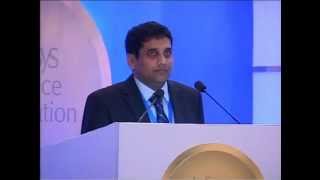
Srinivasa Varadhan - National Medal of Science
YouTube📖 Curated Sources
🌱 What changed because of them
Varadhan’s unified theory of large deviations transformed probability theory, influencing fields like statistical mechanics, finance, and information theory. His leadership at the Courant Institute helped establish it as a global hub for stochastic analysis, while his collaborations set new standards for mathematical rigor and interdisciplinary research. His recognition by the Abel Prize and U.S. National Medal of Science brought greater visibility to Indian mathematicians on the world stage.
💬 Social Buzz
🐦
What are people saying about S. R. Srinivasa Varadhan?
Found a post from a historian, journalist or notable voice? Share it here and help tell their story. 🇮🇳