Pakkiriswamy Chandra Sekharan
Born 15 April 1934 · verify
Died 11 July 2017
Led forensic investigations that helped solve the Rajiv Gandhi assassination case in 1991.
🔔 Add birthday reminderPakkiriswamy Chandra Sekharan was an Indian forensic expert, writer and a former director of the Department of Forensics Sciences of the Government of Tamil Nadu. He was best known for his contributions in the investigations in the Rajiv Gandhi assassination case.
✨ A detail that surprised us
He invented a device called the electronic skull identification device that uses video superimposition to match skulls with photographs for victim identification.
1. In 1986, at the University of Madras, Pakkiriswamy Chandra Sekharan earned a PhD in forensic science, marking a pivotal moment for Indian forensic research.
2. 🌟 During the 1991 investigation of Rajiv Gandhi's assassination, he invented the electronic skull identification device to identify victims using video superimposition techniques.
3. In May 1991, he revealed that the assassin was a woman who acted as a human bomb, reconstructing the belt bomb’s two-switch circuitry from fragmented debris.
4. 🌟 As director of Tamil Nadu's Department of Forensic Sciences, he independently examined soot layers on wiring at a crime scene, proving that bodies had been burned, a detail overlooked by police.
5. In 1991, Sekharan played a key forensic role in recovering a stolen 1,500-year-old Chola bronze idol from the UK, using termite soil evidence to confirm its origin in Tamil Nadu.
6. After retiring, he introduced India’s first forensic engineering course at Anna University in 1993, bridging law, engineering, and crime investigation education.
7. 🌟 Awarded the Padma Bhushan in 2000, he was also president of the Forensics International and edited the Indian Journal of Forensic Science.
8. ❓ How did his insistence on forensic independence from police reshape crime scene investigation protocols in India?
Awards & Honours
- 🏅Padma Bhushan · 2000
🔍 One thing most people don't know
In 1991, Sekharan demonstrated that the Rajiv Gandhi assassin’s bomb belt had a two-switch mechanism, one to arm and another to detonate, reconstructed from tiny electrical components found at the blast site.
🖼️ Through the Years
📷 No photos yet
📅 The Journey
🗝️ Discoveries
"The crime was committed before the whole world as there was so much media present there and so many photographs taken just before and immediately after the bomb blast. Yet nobody was able to determine just what had occurred. That's why it is necessary that every major crime scene is investigated by a trained criminalist, not a police officer. This is the system in vogue abroad."
— Pakkiriswamy Chandra Sekharan
🎥 Speeches & Recordings
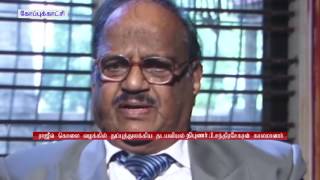
Documentary on my father, Prof. Dr. P. Chandra Sekharan
YouTube📖 Curated Sources
🌱 What changed because of them
Chandra Sekharan’s work on the Rajiv Gandhi assassination set new standards for forensic investigation in India, emphasizing the importance of trained criminalists over traditional police inspections at crime scenes. His leadership transformed Tamil Nadu’s forensic department into a teaching and research hub, influencing forensic science education nationwide. The forensic proof he provided to recover the Chola bronze idol highlighted the application of scientific evidence in art repatriation cases.
💬 Social Buzz
🐦
What are people saying about Pakkiriswamy Chandra Sekharan?
Found a post from a historian, journalist or notable voice? Share it here and help tell their story. 🇮🇳