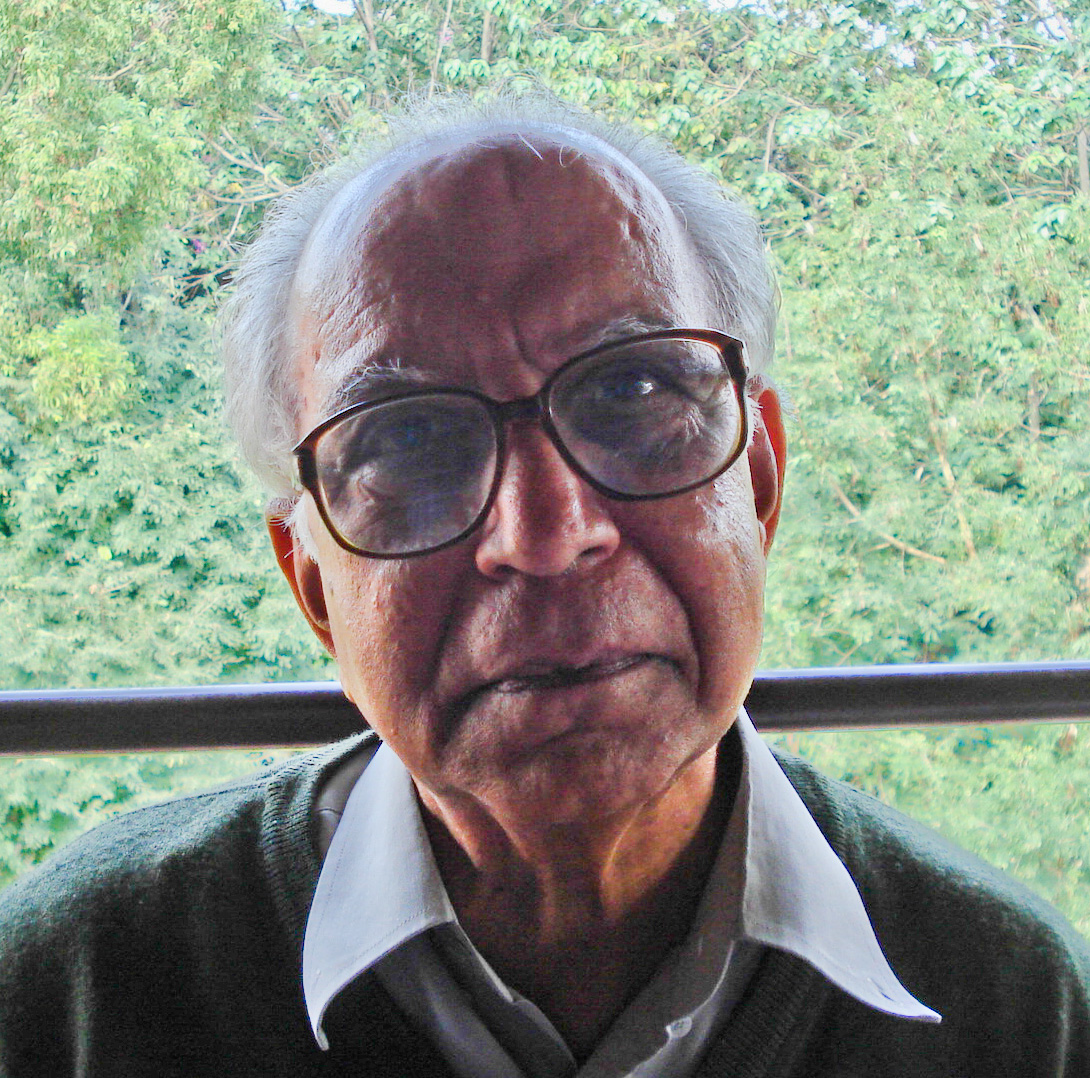
M. S. Narasimhan
Born 7 June 1932 · Tamil Nadu
Died 16 May 2021
Developed the Narasimhan–Seshadri theorem on stable vector bundles over Riemann surfaces.
🔔 Add birthday reminderMudumbai Seshachalu Narasimhan FRS was an Indian mathematician. His focus areas included number theory, algebraic geometry, representation theory, and partial differential equations. He was a pioneer in the study of moduli spaces of holomorphic vector bundles on projective varieties. His work is considered the foundation for Kobayashi–Hitchin correspondence that links differential geometry and algebraic geometry of vector bundles over complex manifolds.
✨ A detail that surprised us
During his time in France in the late 1950s, Narasimhan was hospitalized with pleurisy but later recalled this period as his introduction to the 'real France' and a catalyst for his leftist political sympathies.
1. In 1957, M. S. Narasimhan embarked on a research stint at CNRS in Paris, where despite contracting pleurisy and hospitalization, he immersed himself in the works of French giants like Jean-Pierre Serre and Élie Cartan, shaping his future mathematical directions.
2. 🌟 In 1960, he earned his PhD from the University of Mumbai under K. S. Chandrasekharan, completing a thesis that laid groundwork in partial differential equations and number theory, grounding him firmly in India's growing mathematical scene.
3. In 1965, Narasimhan became a professor at Tata Institute of Fundamental Research (TIFR), Bombay, where he pioneered the study of moduli spaces of holomorphic vector bundles, a topic bridging algebraic and differential geometry.
4. 🌟 Together with C. S. Seshadri, Narasimhan proved the Narasimhan–Seshadri theorem, which gave necessary and sufficient conditions for stable vector bundles on Riemann surfaces, a result linking complex geometry and representation theory with powerful implications in mathematical physics.
5. In the late 1980s, his work won him the Ordre national du Mérite from France (1989) and the Padma Bhushan from India (1990), reflecting recognition across continents for his mathematical achievements.
6. 🌟 From 1993 to 1999, Narasimhan led the Mathematics section at the International Centre for Theoretical Physics (ICTP) in Trieste, mentoring mathematicians from the developing world and building a strong algebraic geometry school under Abdus Salam's invitation.
7. After retiring from ICTP, he continued influencing Indian mathematics as a distinguished associate at the Indian Institute of Science, Bangalore, fostering research in algebraic geometry and representation theory.
8. ❓ How did Narasimhan’s rural upbringing, early bullock-cart travels to school, and exposure to French mathematical culture converge to influence a theorem that now underpins modern gauge theory in physics?
Awards & Honours
- 🏅Shanti Swarup Bhatnagar Prize for Science and Technology
🔍 One thing most people don't know
Narasimhan’s collaboration with Japanese mathematician Takeshi Kotake led to the Kotake–Narasimhan theorem on elliptic operators, a result that remains fundamental in ultradifferentiable function theory since the late 1950s.
🖼️ Through the Years
📅 The Journey
🗝️ Discoveries
🎥 Speeches & Recordings
Eureka with M S Narasimhan
YouTube📖 Curated Sources
🌱 What changed because of them
Narasimhan’s work, especially the Narasimhan–Seshadri theorem, created a crucial bridge between algebraic geometry and differential geometry, influencing mathematical physics and gauge theory. His leadership at TIFR and ICTP helped establish India and developing countries on the global mathematical map by nurturing generations of mathematicians and building institutional capacity in algebraic geometry and related fields.
💬 Social Buzz
🐦
What are people saying about M. S. Narasimhan?
Found a post from a historian, journalist or notable voice? Share it here and help tell their story. 🇮🇳