Krishen Khanna, Painter
Painter

Krishen Khanna

Born 5 August 1925 · Outside India

Created the Truckwallahs and Bandwallahs series depicting Indian street life in abstracted figurative style.

🔔 Add birthday reminder

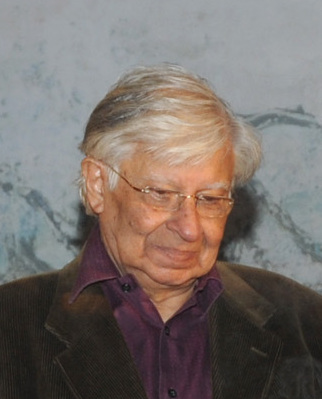
Krishen Khanna is an Indian painter known for his abstracted figurative artworks depicting street scenes of the country. He is a self-taught artist whose paintings showcase Indian idioms and human values. Notable works by Khanna include the Truckwallahs and Bandwallahs series as well as his paintings on Christian themes.

✨ A detail that surprised us

In 1962, Krishen Khanna became the first Indian awarded the Rockefeller Fellowship, enabling him to live and work as an artist-in-residence at American University in Washington, D.C.

1. 🎨 In 1938, at just 13, Krishen Khanna left Bombay aboard the RMS Strathmore to study art at the Imperial Service College in England, marking his first formal encounter with artistic training.

2. In 1946, Khanna enrolled in Sheikh Ahmed's studio in Lahore and simultaneously worked at Kapoor Art Works, where he earned Rs 350 monthly and bought his first artwork by Prannath Mago with his salary.

3. 🚗 On 12 August 1947, amidst the Partition riots, Khanna’s family fled Lahore by car to Shimla, a traumatic move that deeply influenced his later paintings depicting displacement and human struggle.

4. In 1948, Khanna began working at Grindlays Bank in Mumbai, balancing a stable job while connecting with the Progressive Artists' Group, which included MF Husain and FN Souza.

5. 🎖️ Quitting banking in 1961, Khanna pursued art full-time and won the Rockefeller Fellowship in 1962, leading to an artist residency at the American University in Washington, D.C., where he experimented with Abstract Expressionism.

6. 🖼️ Between 1992 and 1997, Khanna hand-painted the colossal mural The Great Procession for ITC Maurya Hotel, New Delhi, assembling it piece by piece in the lobby over five years, capturing Indian life’s diverse rhythms.

7. His paintings often cameo himself, as seen in his vibrant Bandwallahs series celebrating joyous occasions including his own marriage procession, blending personal memory with wider social narratives.

8. ❓ How did Khanna's experiences of Partition, migration, and urban street life shape his unique narrative style within Indian modern art?

Awards & Honours

  • 🏅Padma Bhushan

🔍 One thing most people don't know

At age 13 in 1938, Khanna won the Rudyard Kipling Scholarship, traveling from Bombay to Britain on the RMS Strathmore to attend the Imperial Service College, where he first formally studied art.

🖼️ Through the Years

📷 No photos yet

📅 The Journey

← Drag to explore →
🕊️

Birth in Lyallpur, Punjab

Krishen Khanna was born in Lyallpur, Punjab Province (now Faisalabad, Pakistan), setting the stage for his life across a turbulent subcontinent.

Wikipedia

📚

Rudyard Kipling Scholarship to England

At age 13, Khanna won a scholarship and traveled on RMS Strathmore from Bombay to England to study at the Imperial Service College.

📚

Studied drawing in Lahore

Khanna enrolled in Sheikh Ahmed's studio and worked at Kapoor Art Works, learning painting and printing techniques.

🌟

Migration to Shimla post-Partition

Amidst Partition violence, Khanna’s family fled Lahore to Shimla by car, an event that profoundly influenced his art.

Started banking job in Mumbai

Khanna joined Grindlays Bank as an officer, supporting his family while engaging with Mumbai's artistic circles.

Quit banking to pursue art full-time

Khanna left his banking career to focus entirely on painting, soon winning the Rockefeller Fellowship in 1962.

Completed The Great Procession mural

Finished his massive hand-painted mural at ITC Maurya, New Delhi, after five years of painstaking work assembling it on site.

+Add a moment
1925Birth
1938
1946
1947
1948
1961
1997

🗝️ Discoveries

🏆

Khanna’s first significant artwork sale was Spring Nude in the late 1950s, bought by nuclear physicist Homi Bhabha, marking his entry into professional art circles.

Source: CN Traveller India

🏆

The Great Procession mural took five years (completed in 1997) to paint and assemble at ITC Maurya’s central lobby, showcasing Khanna’s meticulous hand-painting technique on a massive curved dome.

Source: CN Traveller India

👤

Despite being largely self-taught, Khanna passed the Oxford and Cambridge School of Certificate with arts subjects in 1942 during WWII, demonstrating early academic art aptitude.

Source: Wikipedia

🔍

Khanna’s Bandwallahs series not only depicts street musicians but includes a secret cameo of himself, blending personal life with wider social narratives.

Source: CN Traveller India

"All great art has to be local… At the same time, great art transcends the ordinary moment and strives to a moment in infinity"

Krishen Khanna

🎥 Speeches & Recordings

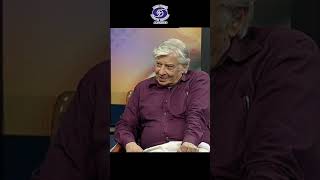
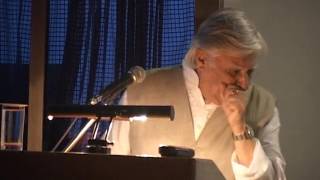
In Conversation with Krishen Khanna | Painter

Experience an insightful conversation with painter Krishen Khanna, exploring his artistic journey and vision.

YouTube

krishen khanna

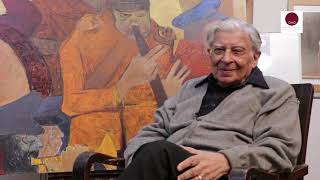
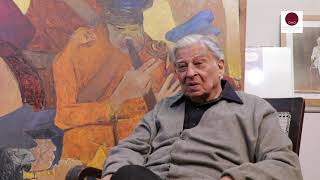
Watch an exclusive interview with Krishen Khanna by Vinod Bhardwaj, revealing the artist's inspirations and work.

YouTube

📖 Curated Sources

🌱 What changed because of them

Krishen Khanna’s vivid depictions of everyday Indian street life and migrant laborers introduced an empathetic narrative to modern Indian art, influencing the Progressive Artists' Group and beyond. His monumental mural at ITC Maurya Hotel remains a rare example of large-scale, hand-painted Indian art in a corporate space, bridging traditional themes with contemporary public art. His recognition by institutions like the Lalit Kala Akademi and the Indian government helped legitimize genre painting as a serious art form in India.

💬 Social Buzz

🐦

What are people saying about Krishen Khanna?

Found a post from a historian, journalist or notable voice? Share it here and help tell their story. 🇮🇳

💭 Memories & Tributes

Share your memory of Krishen Khanna...
Loading memories...
Is this profile accurate?