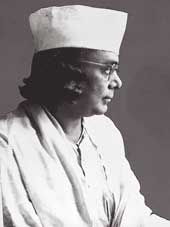
Kazi Nazrul Islam
Born 24 May 1899 · West Bengal
Died 29 August 1976
Writing the revolutionary Bengali poem 'Bidrohī' that inspired anti-colonial sentiment.
🔔 Add birthday reminderKazi Nazrul Islam was a Bengali poet, short story writer, journalist, lyricist and musician. He was later honored with the title of national poet of Bangladesh. Nazrul produced a large body of poetry, music, messages, novels, and stories with themes, that included equality, justice, anti-imperialism, humanity, rebellion against oppression and religious devotion. Nazrul Islam's activism for political and social justice as well as writing a poem titled as "Bidrohī", meaning "the rebel" in Bengali, earned him the title of "Bidrohī Kôbi".
✨ A detail that surprised us
Nazrul Islam directed the 1934 film "Dhrubo," for which he composed 17 of 18 songs and acted in a comedic role, a rare crossover for poets of his era.
1. 🌟 In 1917, Kazi Nazrul Islam enlisted in the British Indian Army and was stationed in Karachi, an experience that exposed him to diverse cultures and later fueled his revolutionary spirit in writing.
2. In 1922, his poem "Bidrohī" ('The Rebel') was published, electrifying Bengal with its call for uprising and earning him the title "Bidrohī Kôbi"; this poem challenged British colonial rule with unprecedented boldness.
3. 🚨 His 1924 anthology "Bhangar Gan" ('The Song of Destruction') was seized and banned by the British government, signaling the disruptive power of his words against imperial authority.
4. Between 1934 and 1938, Nazrul expanded into cinema, directing the film "Dhrubo," composing nearly all 18 songs for it, and acting in comedic roles, blending his literary talents into emerging Bengali film culture.
5. 🕌 Raised in a Bengali Muslim family in Churulia, West Bengal, Nazrul’s early education in Quran, Hadith, and Islamic philosophy deeply influenced his poetry’s fusion of spiritual devotion and secular rebellion.
6. By 1942, at age 43, he was afflicted by Pick's disease, a rare neurodegenerative disorder that progressively silenced his voice and memory, yet his legacy continued to inspire.
7. 🇧🇩 In 1972, after decades of illness and exile, the government of Bangladesh brought Nazrul to Dhaka, granting him citizenship in 1976 just months before his death, cementing his identity as the national poet of Bangladesh.
8. ❓ What hidden tensions existed between Nazrul’s radical calls for unity and the religious fundamentalism that condemned his liberal views during his lifetime?
Awards & Honours
- 🏅Padma Bhushan
🔍 One thing most people don't know
In 1922, Nazrul was imprisoned by the British for his seditious writings in the magazine Dhūmketu, during which he wrote "Rajbôndīr Jôbanbôndī" ('Deposition of a Political Prisoner') and undertook a hunger strike to protest political prisoner mistreatment.
🖼️ Through the Years


📅 The Journey
🗝️ Discoveries
"I am the unutterable grief."
— Kazi Nazrul Islam
🎥 Speeches & Recordings
documentary of Kabi Kazi Nazrul Islam।#সংগৃহীত
YouTube📖 Curated Sources
🌱 What changed because of them
Nazrul Islam’s revolutionary poetry and music challenged British colonial rule and inspired anti-imperialist movements across Bengal, contributing to the cultural awakening that fueled India’s independence efforts. His promotion of Hindu-Muslim unity influenced social and political discourse in both India and Bangladesh, leading Bangladesh to honor him as their national poet and name institutions after him. His fusion of Arabic-Persian vocabulary into Bengali literature also expanded the linguistic and cultural horizons of Bengali arts.
💬 Social Buzz
🐦
What are people saying about Kazi Nazrul Islam?
Found a post from a historian, journalist or notable voice? Share it here and help tell their story. 🇮🇳