JA
Indian Army General

Jagjit Singh Aurora

Born 13 February 1916 ยท Pakistan

Died 3 May 2005

Led the Indian Eastern Command to victory in the 1971 Bangladesh Liberation War.

๐Ÿ”” Add birthday reminder

Lieutenant General Jagjit Singh Aurora, PVSM was an Indian senior military officer who was the General Officer Commanding-in-Chief (GOC-in-C) Eastern Command during the Bangladesh Liberation War and the Indo-Pakistani War of 1971. He organised and led the ground forces campaign in the Eastern Front of the war, which led to an overwhelming defeat of the combined Pakistan Armed Forces in East-Pakistan that led to the creation of Bangladesh.

โœจ A detail that surprised us

Jagjit Singh Aurora personally received the formal surrender of 93,000 Pakistani soldiers in Dhaka in 1971, one of the largest surrenders in modern military history.

1. In 1939, Jagjit Singh Aurora was commissioned into the 1st Battalion, 2nd Punjab Regiment from the Indian Military Academy, marking the start of a military career spanning key conflicts across decades.

2. ๐ŸŒ During the brutal Burma Campaign of World War II, Aurora gained frontline combat experience that shaped his strategic acumen for future wars in South Asia.

3. In the Indo-Pakistani War of 1947-48, as a lieutenant colonel commanding 1 (Para) Battalion, he was mentioned in dispatches for his leadership during fierce fighting in Kashmir.

4. ๐Ÿš In 1961, as Brigadier and BGS XXXIII Corps, he led an Indian military reconnaissance mission to Bhutan, laying groundwork for the Indian Military Training Team's establishment there.

5. By June 1969, Aurora was appointed General Officer Commanding-in-Chief Eastern Command, a pivotal role he would hold during the Indo-Pakistani War of 1971.

6. โš”๏ธ In 1971, as commander of the Indian and Bangladesh joint forces, he orchestrated the swift surrender of nearly 93,000 Pakistani troops in Dhaka on December 16, effectively ending the Bangladesh Liberation War.

7. After retirement, Aurora opposed the 1984 Indian Army attack on the Golden Temple and advocated for victims of the 1984 anti-Sikh riots, showing his engagement in political and social issues beyond the battlefield.

8. โ“ How did a soldier born in pre-Partition Punjab evolve into the commander whose actions reshaped the geopolitical map of South Asia in 1971?

Awards & Honours

  • ๐Ÿ…Padma Bhushan

๐Ÿ” One thing most people don't know

In May 1961, Aurora led a military reconnaissance mission to Bhutan, which was instrumental in establishing the Indian Military Training Team, a continuing security partnership with Bhutan.

๐Ÿ–ผ๏ธ Through the Years

๐Ÿ“ท No photos yet

๐Ÿ“… The Journey

โ† Drag to explore โ†’
๐Ÿ•Š๏ธ

Born in Kala Gujran, Jhelum District

Jagjit Singh Aurora was born into a Sikh family in British India, in what is now Pakistan.

โ€” Wikipedia

โšก

Commissioned into 2nd Punjab Regiment

Graduated from Indian Military Academy and joined 1st Battalion, 2nd Punjab Regiment.

โšก

Commanded 1 (Para) Battalion in Kashmir

Mentioned in dispatches for leadership during Indo-Pakistani War of 1947-48 in Kashmir.

โšก

Led reconnaissance mission to Bhutan

Brigadier Aurora headed Indian military team whose work led to Indian Military Training Team's foundation in Bhutan.

โšก

Appointed GOC-in-C Eastern Command

Took command of the Eastern Command, overseeing Indian forces on the crucial eastern front.

โšก

Accepted Pakistani surrender in Dhaka

Received surrender of 93,000 Pakistani troops, ending the Bangladesh Liberation War.

๐Ÿ•Š๏ธ

Passed away in New Delhi

Jagjit Singh Aurora died at age 89, remembered by Bangladesh and India.

+Add a moment
1916Birth
1939
1947
1961
1969
1971
2005

๐Ÿ—๏ธ Discoveries

๐Ÿ†

During the 1971 war, Aurora supervised the training and equipping of the Mukti Bahini guerrillas, transforming a ragtag group into an effective fighting force against Pakistan Army.

Source: SikhiWiki

๐Ÿ‘ค

Aurora was one of the few senior Indian Army officers who publicly opposed the 1984 army operation on the Golden Temple and later advocated for victims of the anti-Sikh riots that same year.

Source: SikhiWiki

๐ŸŒ

He was commissioned into the 2nd Punjab Regiment in 1939 and fought through the Burma Campaign in World War II, giving him frontline experience against Japanese forces.

Source: Wikipedia

๐Ÿ’ก

The surrender he accepted in Dhaka involved the Pakistani Eastern Command led by Lt Gen A. A. K. Niazi, who removed his badges and pistol before handing over to Aurora.

Source: Role of Pakistan Army in 1971 Bangladesh Genocide PDF

๐ŸŽฅ Speeches & Recordings

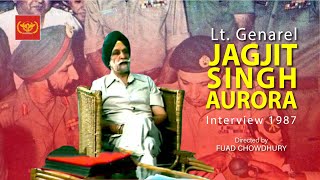
Lt Gen JAGJIT SINGH AURORA I. 1987 I Fuad Chowdhury

A rare 1987 interview featuring Lt Gen Jagjit Singh Aurora sharing his insights and experiences.

YouTube

Lt. Gen. Jagjit Singh Aurora's interview (1987)about Pakistan Army Surrenders In Bangladesh

An exclusive 1987 interview with Lt. Gen. Jagjit Singh Aurora discussing the Pakistan Army surrender in Bangladesh.

YouTube

๐Ÿ“– Curated Sources

๐ŸŒฑ What changed because of them

Auroraโ€™s leadership in the Eastern Command directly enabled the creation of Bangladesh by coordinating Indian and Mukti Bahini forces, ending over nine months of conflict. His tactics and joint operations became case studies in modern guerrilla and combined warfare. Post-retirement, his vocal stance against the 1984 Golden Temple assault influenced Sikh political activism and human rights discourse in India.

๐Ÿ’ฌ Social Buzz

๐Ÿฆ

What are people saying about Jagjit Singh Aurora?

Found a post from a historian, journalist or notable voice? Share it here and help tell their story. ๐Ÿ‡ฎ๐Ÿ‡ณ

๐Ÿ’ญ Memories & Tributes

Share your memory of Jagjit Singh Aurora...
Loading memories...
Is this profile accurate?