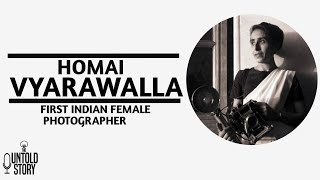
Homai Vyarawalla, Photojournalist
Photojournalist

Homai Vyarawalla

Born 9 December 1913 · Maharashtra — Died 15 January 2012

India's first woman photojournalist who documented key moments from 1938 to 1970.

Homai Vyarawalla, commonly known by her pseudonym Dalda 13, was India's first woman photojournalist. She began her career in 1938 working for the Bombay Chronicle, capturing images of daily life in the city. Vyarawalla worked for the British Information Services from the 1940s until 1970 when she retired. In 2011, she was awarded Padma Vibhushan, the second highest civilian award of the Republic of India.

A detail that
surprised us

Homai Vyarawalla’s early photographs were published under her husband’s name because newspapers refused to credit a woman photojournalist in the 1930s India.

The Story

1. In 1938, a young woman named Homai Vyarawalla began snapping photos for the Bombay Chronicle, yet her pictures were initially published under her husband’s name due to gender bias in journalism. 2. 📸 By 1942, Homai and her husband moved to Delhi, where she became a familiar sight cycling with her camera strapped to her back, capturing the birth of a new India under the British Information Service. 3. 🕊️ In 1947, she immortalized the chaos and hope of India’s Independence, photographing iconic moments like Jawaharlal Nehru’s first Republic Day parade, blending history and humanity through her lens. 4. 🌏 In 1956, her camera captured the 14th Dalai Lama’s first entrance into India via the Nathu La pass, a moment of profound geopolitical and spiritual significance. 5. Throughout her career, Homai operated under the pseudonym "Dalda 13," a secret identity born out of necessity, allowing her to navigate a male-dominated profession unseen and unrestricted. 6. After retiring in 1970, following her husband’s death, she withdrew from photography, rejecting the rising paparazzi culture she disdained, marking the end of an era defined by dignity and depth in photojournalism. 7. ❓ What untold stories and unseen perspectives might have been lost without Homai Vyarawalla’s fearless camera eye chronicling India’s tumultuous transformation from colony to republic?

🏅 Awards & Honours

Padma Vibhushan

🔍 One thing most people don't know

Homai’s pseudonym “Dalda 13” originated as a protective alias because her early work was not accepted under a woman’s name, a unique strategy for female journalists in the 1940s.

🖼️

Through the Years

2 photographs from the archives
Homai Vyarawalla receiving the 1st National Photo Award from Vice President Mohd. Hamid Ansari in New Delhi (2010).
2010
Homai Vyarawalla receiving the Padma Vibhushan Award from President Pratibha Patil at Rashtrapati Bhavan (2011).

🗓️ A Life in Moments

🕊️
Birth
Born in Navsari, Gujarat
Homai Vyarawalla was born into a Parsi family in Navsari, Bombay State, British India, beginning a life that would document the nation’s transformation.
1913
Career
Begins photojournalism career
Started working for the Bombay Chronicle, capturing daily life in Mumbai, though her photos were initially credited to her husband.
1938
Career
Moves to Delhi with husband
Joined British Information Services as photographers, establishing her presence in the capital’s journalistic circles.
1942
Career
Documents Indian Independence
Captured landmark moments including Nehru’s speeches and early Republic Day parades, visually chronicling India’s birth as a nation.
1947
Career
Photographs Dalai Lama entering India
Took the iconic photo of the 14th Dalai Lama crossing into India through Nathu La, a profound historical moment.
1956
Career
Retires from photography
Retired following her husband’s death, choosing to step away as paparazzi culture rose in India.
1970
🏅
Award
Awarded Padma Vibhushan
Received India’s second highest civilian honor, recognizing her pioneering contributions to photojournalism.
2011
🕊️
Death
Passes away in Vadodara
Died at the age of 98, leaving behind an invaluable visual legacy of modern India’s history.
2012
More moments to come...
+ Add a moment

🗝️Discoveries

Swipe to uncover hidden stories
01 / 05
🌍HISTORICAL IMPACT

In 1956, Homai captured the rare moment of the 14th Dalai Lama entering India through the Nathu La pass, a historic event marking the beginning of Tibetan exile in India.

02 / 05
👤PERSONAL

Despite her groundbreaking career, Homai stopped photography entirely in 1970 after her husband’s death, disillusioned by the emerging paparazzi culture she felt lacked integrity.

03 / 05
🏆ACHIEVEMENT

Homai was among the first women in India to join a mainstream publication, The Illustrated Weekly of India, in the 1940s, breaking gender barriers in Indian media.

“I hadn’t the slightest clue I would be a photographer. I wanted to be a doctor but that was the only time in my life that my mother refused to let me do something. She had seen doctors on late-night shifts and didn’t want me in a profession like that. Little did she realize that press photography would be far worse!”

Homai Vyarawalla

🎙️ Speeches & Recordings

These recordings preserve the legacy of Bharat's icons
Biography of Homai Vyarawalla The Untold Story
·YouTube
More from this archive
Biography of Homai Vyarawalla The Untold Story
01
Biography of Homai Vyarawalla The Untold Story
YouTube
KHOJ MARATHON : Homai Vyarawalla
02
KHOJ MARATHON : Homai Vyarawalla
YouTube

🌱 What changed because of them

Homai Vyarawalla’s work established a visual archive of India’s most pivotal moments from the 1930s to 1970, influencing photojournalistic standards and inspiring women photographers across the country. Her pioneering role led to recognition such as the Padma Vibhushan in 2011 and helped pave the way for broader acceptance of women in Indian media professions.

💬 Social Buzz

💬

What are people saying about Homai Vyarawalla?

Share posts from historians, journalists and notable voices about this icon. 🇮🇳

💭 Memories & Tributes

Share your memory of Homai Vyarawalla...
Loading memories...
Is this profile accurate?