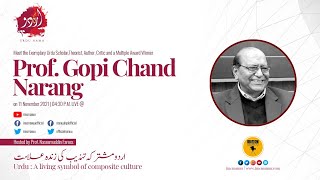
Gopi Chand Narang, Literary Critic and Scholar
Literary Critic and Scholar

Gopi Chand Narang

Born 16 November 1931 · Uttar Pradesh — Died 15 June 2022

Pioneered modern Urdu literary criticism using structuralism and post-structuralism frameworks.

Gopi Chand Narang was an Indian theorist, literary critic, and scholar who wrote in Urdu and English. His Urdu literary criticism incorporated a range of modern theoretical frameworks including stylistics, structuralism, post-structuralism, and Eastern poetics.

✨

A detail that
surprised us

“

Although Urdu was not his mother tongue—his family spoke Saraiki—Narang considered his journey with Urdu a 'journey of ishq' that deeply shaped his scholarly life.

The Story

1
In 1931, Gopi Chand Narang was born in Dukki, Balochistan, a region now in Pakistan, where his father Dharam Chand Narang, a scholar of Persian and Sanskrit, inspired his early literary curiosity.
2
🌟 By 1958, Narang completed his PhD at the University of Delhi, producing pioneering research on the Karkhandari Dialect of Delhi Urdu, spotlighting a neglected artisan community’s language.
3In the early 1960s, Narang taught Urdu literature at St. Stephen's College and Delhi University, before becoming a visiting professor at American universities like Wisconsin and Minnesota, bridging South Asian and Western literary studies.
4📚 His 1987 work, "Amir Khusrow ka Hindavi Kalaam," revived interest in Indo-Islamic literary traditions, demonstrating how Urdu poetry drew deeply from Hindu epics like the Mahabharata and Ramayana.

🏅 Awards & Honours

—
Padma Bhushan

🔍 One thing most people don't know
“

Narang’s first published book in 1961 was a sociolinguistic study of the Karkhandari Dialect, a variety of Delhi Urdu spoken by indigenous artisans, a community often overlooked in literary studies.

🖼️

Through the Years

2 photographs from the archives
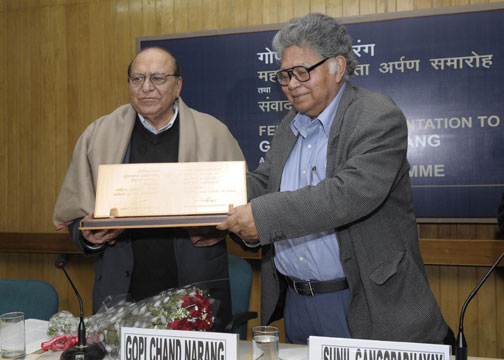
Gopi Chand Narang receiving the Sahitya Akademi Fellowship Award in a group photo (2010)
2010
The Vice President presenting the Moortidevi statue to Prof. Gopi Chand Narang in New Delhi (2012)

🗓️ A Life in Moments

🕊️
Birth
Born in Dukki, Balochistan
Gopi Chand Narang was born in Dukki, British India (now Pakistan), to Dharam Chand Narang, a scholar of Persian and Sanskrit.
1931
📚
Education
Completed PhD at University of Delhi
Narang earned his doctorate with a research fellowship from the Ministry of Education, focusing on Urdu literary topics.
1958
📖
Publication
Published first book on Karkhandari Dialect
His debut publication was a sociolinguistic analysis of a neglected dialect of Delhi Urdu spoken by indigenous artisans.
1961
⚡
Career
Visiting professor at University of Wisconsin
Narang taught Urdu literature abroad, engaging with Western academia and expanding Urdu studies internationally.
1963
📖
Publication
Published 'Amir Khusrow ka Hindavi Kalaam'
This work highlighted the integration of Hindu epics into Urdu poetic tradition, reviving interest in Indo-Islamic literary culture.
1987
⚡
Career
Vice-chairman of Delhi Urdu Academy
Narang took on a leadership role advocating for Urdu language promotion in the capital region.
1996
🏅
Award
Received Mazzini Gold Medal, Italy
Narang was awarded this international honor recognizing his contributions to literature and culture.
2005
🕊️
Death
Passed away
Gopi Chand Narang died, leaving behind a vast legacy in Urdu literary criticism and scholarship.
2022
More moments to come...
+ Add a moment

🗝️Discoveries

Swipe to uncover hidden stories
01 / 04
🏆ACHIEVEMENT

In 1997, Narang became a resident fellow at the Rockefeller Foundation Bellagio Center in Italy, an international recognition for his literary scholarship.

02 / 04
🌍HISTORICAL IMPACT

Narang’s research revealed that Urdu poets from Deccan, Delhi, and Lucknow extensively borrowed narratives from Hindu epics like the Mahabharata and Ramayana, challenging colonial historiography’s erasure of Indo-Islamic cultural synthesis.

03 / 04
👤PERSONAL

Despite Urdu being his literary medium, Narang’s mother tongue was Saraiki, a language praised for its sweetness and mellifluous quality, which he mentioned in his book "Urdu Zaban Aur Lisaniyat."

“

"My journey with Urdu is a journey of ishq. Urdu was not my mother tongue; my paternal and maternal families spoke Seraiki. But I never realised that Urdu is not my mother tongue."

— Gopi Chand Narang

🎙️ Speeches & Recordings

These recordings preserve the legacy of Bharat's icons
Gopi Chand Narang - A Literary Odyssey
More from this archive
Gopi Chand Narang - A Literary Odyssey
01
Gopi Chand Narang - A Literary Odyssey
Urdu : A Living symbol of Composite Culture | Prof. Gopi Chand Narang | Urdu Nama |EP-1 | IMC, MANUU
02
Urdu : A Living symbol of Composite Culture | Prof. Gopi Chand Narang | Urdu Nama |EP-1 | IMC, MANUU

🌱 What changed because of them

Gopi Chand Narang redefined Urdu literary criticism by introducing modern theoretical frameworks alongside Eastern poetics, enriching the academic study of Urdu language and literature. His leadership roles at institutions like Delhi Urdu Academy and Sahitya Akademi helped promote Urdu language policy and cultural recognition in post-independence India. His works rekindled interest in neglected literary forms like masnavi and challenged colonial narratives by highlighting the pluralistic, shared heritage of Hindustani culture.

💬 Social Buzz

💬

What are people saying about Gopi Chand Narang?

Share posts from historians, journalists and notable voices about this icon. 🇮🇳

💭 Memories & Tributes

Share your memory of Gopi Chand Narang...
Loading memories...
Is this profile accurate?