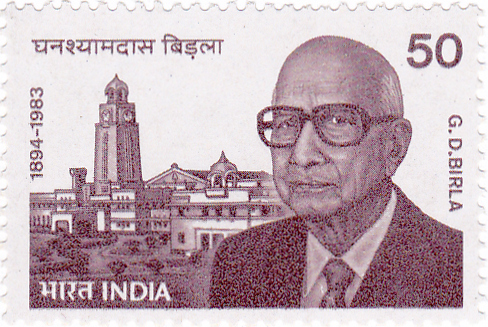
Ghanshyam Das Birla
Born 10 April 1894 · Rajasthan
Died 11 June 1983
Founded the Birla Group, a major Indian industrial conglomerate, and supported the Indian independence movement.
🔔 Add birthday reminderGhanshyam Das Birla was born on 10 April 1894 at Pilani town in Jhunjhunu district, in the region known as Rajputana, as a member of the Marwari Rajasthani community.His father was Raja Baldevdas Birla. In 1884, Baldeo Das Birla went to Bombay in search of new avenues of trade. He established his firm Shiv Narian Baldeo Das in Bombay in 1884 and Baldeo Das Jugal Kishore in 1897 in Calcutta. The firms started business in silver, cotton, grain and other commodities. He was succeeded by 4 sons, Jugal Kishore, Rameshwar Das, Ghanshyam Das and Braj Mohan. Ghanshyam Das was the most successful of the four brothers.
✨ A detail that surprised us
Despite stiff resistance from British and Scottish merchants who tried to block his entry into the jute trade, G.D. Birla successfully launched Birla Jute Mills in 1918, thriving when World War I caused severe supply constraints across the British Empire.
1. In 1918, against the backdrop of British favoritism towards European merchants, Ghanshyam Das Birla launched Birla Jute Mills in Calcutta, defying odds and colonial trade barriers to enter the jute industry dominated by the British.
2. 🌟 By 1919, with an investment of ₹5 million, he founded Birla Brothers Limited and established a mill in Gwalior, marking a strategic diversification from moneylending to manufacturing in India's industrial landscape.
3. In 1926, Birla’s election to the Central Legislative Assembly placed him at the heart of British India's political machinery during a turbulent pre-independence period, blending business acumen with political influence.
4. 🌿 In 1932, he became the first president of the Harijan Sevak Sangh, an organization founded by Mahatma Gandhi to eradicate untouchability, showcasing his commitment to social reform alongside industrial progress.
5. During the 1942 Quit India Movement, Birla conceived United Commercial Bank Limited (UCO Bank), aiming to establish an Indian-controlled commercial bank amidst colonial financial dominance, leading to its founding in Kolkata in 1943.
6. 🚗 In the 1940s, Birla ventured into automobile manufacturing by establishing Hindustan Motors, an ambitious step toward industrial self-reliance in a sector largely controlled by foreign companies before independence.
7. Post-independence, Birla expanded into tea, textiles, cement, chemicals, rayon, and steel tubes through acquisitions of erstwhile European enterprises, systematically Indianizing critical sectors of the economy.
8. ❓ How did Ghanshyam Das Birla’s industrial ventures influence India’s struggle for economic autonomy during colonial rule and shape the country’s post-independence industrial policy?
Awards & Honours
- 🏅Padma Vibhushan · 1957
🔍 One thing most people don't know
In 1918, Birla started as a jute broker in Calcutta, entering an industry heavily dominated by British and Scottish merchants who tried to shut his business down, yet he persevered and succeeded during World War I's supply shortages.
🖼️ Through the Years
📅 The Journey
🗝️ Discoveries
🎥 Speeches & Recordings
🎥 Know a speech or documentary about Ghanshyam Das Birla?
📖 Curated Sources
🌱 What changed because of them
G.D. Birla transformed his family’s traditional moneylending business into a diversified industrial empire that challenged colonial economic dominance, particularly in jute and manufacturing sectors. His founding of educational institutions like the Birla Institute of Technology and Science in Pilani laid foundations for technical education in India. Moreover, his role in establishing UCO Bank marked a crucial step toward Indian financial independence during British rule.
💬 Social Buzz
🐦
What are people saying about Ghanshyam Das Birla?
Found a post from a historian, journalist or notable voice? Share it here and help tell their story. 🇮🇳