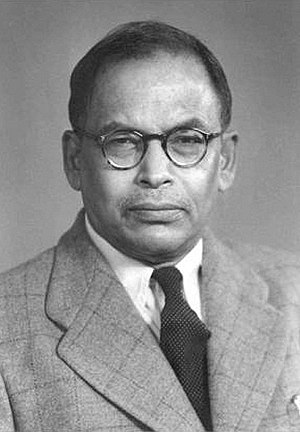
Daulat Singh Kothari, Scientist
Scientist

Daulat Singh Kothari

Born 6 July 1906 · Rajasthan — Died 4 February 1993

Led the Scientific Advisory Committee to the Government of India shaping post-independence science policy.

Daulat Singh Kothari was born in the princely state of Udaipur in Rajputana on 6 July 1906. Kothari was the son of a Jain headmaster.His father died in the the plague epidemic of 1918 and he was raised by his mother. He had his early education at Udaipur and Indore and received a master's degree in physics from Allahabad University in 1928 under guidance of Meghnad Saha. D. S. Kothari "went to Cavendish Laboratory on a U.P. Government fellowship in 1930 and worked with Ernest Rutherford, P. Kapitza, and R. H. Fowler". He was awarded a PhD from Cambridge University in May 1933 with a thesis entitled "The quantum statistics of dense matter" and he published in the Proceeding of the Royal Society, London.

✨

A detail that
surprised us

“

Daulat Singh Kothari was the only Indian invited to contribute an article in the Birth Centenary Volume honoring Niels Bohr, a giant of quantum physics.

The Story

1
In 1930, Daulat Singh Kothari arrived at Cambridge’s Cavendish Laboratory, working alongside Ernest Rutherford and Patrick Blackett on quantum statistics, a rare opportunity for an Indian physicist of his time.
2
🌟 In 1933, he earned his PhD from Cambridge with a thesis on 'The quantum statistics of dense matter,' publishing in the Proceedings of the Royal Society, marking his entry into international scientific discourse.
3Returning to India in 1934, Kothari joined Delhi University, eventually heading the Physics Department until 1961, shaping the academic environment during a period of national transformation.
4🚀 Between 1948 and 1961, as Scientific Advisor to India’s Ministry of Defence, he founded and structured 12 key DRDO laboratories, including the Naval Chemical and Metallurgical Laboratory in Mumbai and the Defence Food Research Laboratory in Mysore.

🏅 Awards & Honours

1962
Padma Bhushan
1973
Padma Vibhushan

🔍 One thing most people don't know

“

In 1918, at age 12, Kothari lost his father to a plague epidemic, yet he secured a scholarship from the Maharana of Mewar in 1924 for topping intermediate science exams in Rajasthan.

📸 Through the Years

📷

No photos yet

Help preserve history — add a photo of this icon

🗓️ A Life in Moments

🕊️
Birth
Born in Udaipur, Rajasthan
Daulat Singh Kothari was born in the princely state of Udaipur to Fateh Lal Kothari, a Jain headmaster.
1906
🌟
Other
Father died in plague epidemic
Kothari’s father passed away during the 1918 plague, leading to his upbringing by his mother and a family friend, the Chief Minister of Indore.
1918
📚
Education
Completed MSc in Physics at Allahabad University
Kothari graduated at the top of his class under the mentorship of Meghnad Saha, beginning his research career.
1928
📚
Education
PhD awarded from Cambridge University
He completed his thesis on quantum statistics of dense matter at Cambridge and published in the Proceedings of the Royal Society.
1933
⚡
Career
Became Scientific Advisor to Ministry of Defence
Kothari began shaping defense science infrastructure, founding numerous DRDO laboratories across India.
1948
⚡
Career
Chaired Indian Education Commission
Led the Kothari Commission that set the blueprint for national education reforms and policy standardization.
1964
🏅
Award
Received Padma Vibhushan and INSA Presidency
Awarded Padma Vibhushan and elected President of the Indian National Science Academy.
1973
🕊️
Death
Passed away
Daulat Singh Kothari died, leaving a lasting legacy in Indian science and education.
1993
More moments to come...
+ Add a moment

🗝️Discoveries

Swipe to uncover hidden stories
01 / 05
🏆ACHIEVEMENT

Kothari worked with Nobel laureate Lord Ernest Rutherford and physicists like P. Kapitza and R. H. Fowler at Cambridge’s Cavendish Laboratory between 1930 and 1933.

02 / 05
🏆ACHIEVEMENT

As Scientific Advisor to the Ministry of Defence, Kothari was instrumental in founding 12 DRDO labs across India, including specialized institutes in Kochi, Mysore, Chennai, and Hyderabad.

03 / 05
🔍LESSER KNOWN

He integrated Indian spirituality with science, writing on 'Atom and the Self' and 'Modern Physics and Syadvad,' reflecting his unique philosophical perspective.

No quote recorded for Daulat Singh Kothari yet.

🌱 What changed because of them

Kothari’s foundation of 12 DRDO laboratories created the backbone of India's defense research infrastructure, which remains crucial today. His chairmanship of the University Grants Commission and leadership of the Kothari Commission report reshaped Indian education policy, embedding standardization and modernization that continue to influence the system. Institutions like Delhi University and Jawaharlal Nehru University benefited directly from his vision and leadership.

💬 Social Buzz

💬

What are people saying about Daulat Singh Kothari?

Share posts from historians, journalists and notable voices about this icon. 🇮🇳

💭 Memories & Tributes

Share your memory of Daulat Singh Kothari...
Loading memories...
Is this profile accurate?