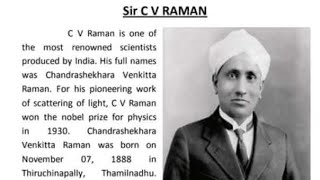
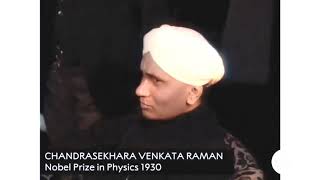
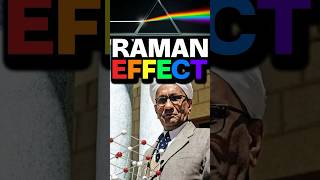
C. V. Raman, Physicist, Nobel Laureate
Physicist, Nobel Laureate

C. V. Raman

Born 7 November 1888 ยท Tamil Nadu โ€” Died 21 November 1970

Discovered the Raman Effect demonstrating wavelength change in scattered light in 1928.

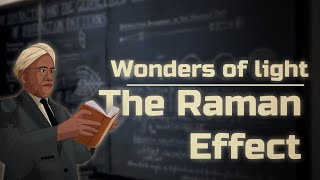
Sir Chandrasekhara Venkata Raman was an Indian physicist known for his work in the field of light scattering. Using a spectrograph that he developed, he and his student K. S. Krishnan discovered that when light traverses a transparent material, the deflected light changes its wavelength.

โœจ

A detail that
surprised us

โ€œ

Raman booked his Nobel Prize trip to Sweden four months before the actual announcement in 1930, confident of his win.

The Story

1
In 1921, during a sea voyage to Europe, Raman became fascinated by the mysterious blue hue of the Mediterranean Sea, sparking experiments on light scattering that led to his groundbreaking discovery.
2
๐ŸŒŸ On 28 February 1928, Raman and his student K. S. Krishnan demonstrated that scattered light changes wavelength when passing through transparent materials, a phenomenon now called the Raman effect.
3In 1930, he defied convention by booking his Nobel Prize trip to Sweden months before the announcement, becoming the first Asian and non-White scientist awarded the Nobel Prize in Physics.
4At just 16, Raman topped his physics degree at Presidency College, Madras, and published his first research paper on light diffraction in 1906, marking the start of his prolific career.

๐Ÿ… Awards & Honours

โ€”
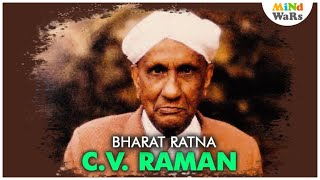
Bharat Ratna

๐Ÿ” One thing most people don't know

โ€œ

Ramanโ€™s fascination with the blue color of the sea began during a 1921 voyage to Europe, leading to experiments that debunked the prevailing Rayleigh scattering explanation for the seaโ€™s blue hue.

๐Ÿ–ผ๏ธ

Through the Years

3 photographs from the archives
C. V. Raman in the BA class photo at Presidency College, Madras (1903)
1903
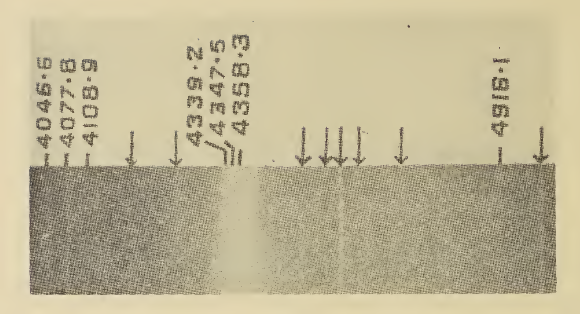
Raman spectrum of Benzene published by C. V. Raman and Krishnan in Nature (1928)
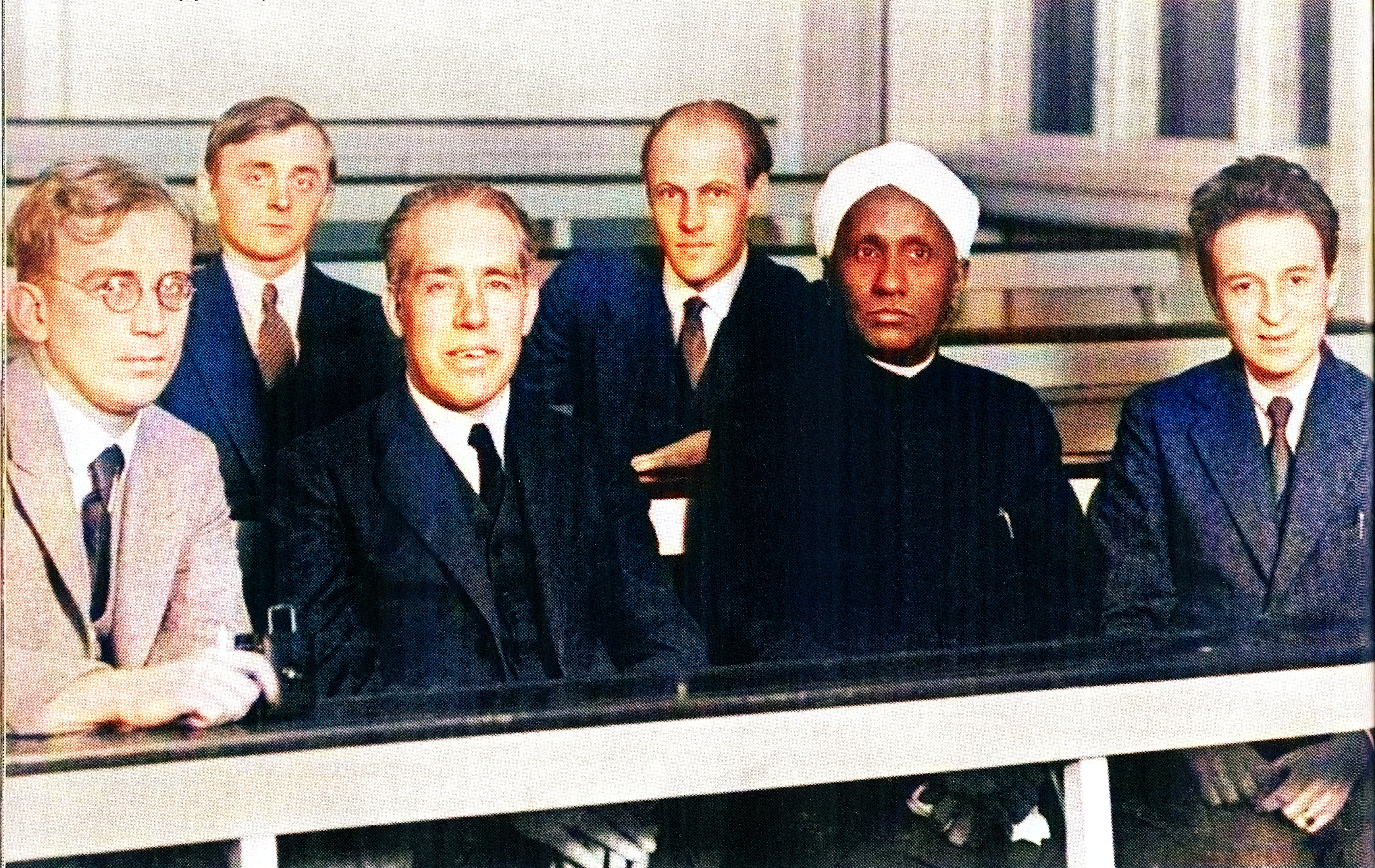
C. V. Raman with physicist Niels Bohr during a scientific meeting (year unknown)

๐Ÿ—“๏ธ A Life in Moments

๐Ÿ•Š๏ธ
Birth
Birth in Tiruchirappalli, Tamil Nadu
Chandrasekhara Venkata Raman was born to Tamil Brahmin parents in the Madras Presidency, British India.
1888
๐Ÿ“š
Education
Graduated from Presidency College
Raman topped his BA physics degree at age 16 from the University of Madras, winning gold medals in physics and English.
1904
๐Ÿ“–
Publication
Published first research paper
At 18, Raman published a paper on light diffraction in Philosophical Magazine, marking his entry into scientific research.
1906
โšก
Career
Appointed Palit Professor of Physics
Raman joined the University of Calcutta as the first Palit Professor of Physics, focusing on acoustics and optics research.
1917
โšก
Career
Discovery of the Raman Effect
Raman and K. S. Krishnan discovered the change in wavelength of scattered light, a new form of light scattering.
1928
๐Ÿ…
Award
Awarded Nobel Prize in Physics
Raman received the Nobel Prize for his work on light scattering, becoming the first Asian Nobel laureate in sciences.
1930
โšก
Career
Director of Indian Institute of Science
Raman became the first Indian director at IISc Bangalore, later founding the Indian Academy of Sciences in 1934.
1933
โšก
Career
Established Raman Research Institute
After independence, Raman founded the Raman Research Institute in Bangalore, dedicating his final years to research.
1948
๐Ÿ•Š๏ธ
Death
Death in Bangalore
C. V. Raman passed away in Bangalore, leaving behind a legacy in Indian and global physics.
1970
More moments to come...
+ Add a moment

๐Ÿ—๏ธDiscoveries

Swipe to uncover hidden stories
01 / 04
๐Ÿ†ACHIEVEMENT

At age 18, while still a student, Raman published his first scientific paper on 'Unsymmetrical diffraction-bands due to a rectangular aperture' in the prestigious Philosophical Magazine (1906).

02 / 04
๐Ÿ”LESSER KNOWN

Despite never earning a formal PhD, Raman began supervising research students by 1915 and held a full professorship at the University of Calcutta by 1917.

03 / 04
๐Ÿ†ACHIEVEMENT

Raman and physicist Suri Bhagavantam discovered quantum photon spin in 1932, reinforcing the quantum theory of light beyond his famous Raman effect.

โ€œ

"If I had discovered the Raman effect earlier, I should have shared the Nobel Prize with Compton and I should not have liked that; I would rather receive the whole of it."

โ€” C. V. Raman

๐ŸŽ™๏ธ Speeches & Recordings

These recordings preserve the legacy of Bharat's icons
Mars & Beyond - C V Raman: The scientist and his legacy
More from this archive
Mars & Beyond - C V Raman: The scientist and his legacy
01
Mars & Beyond - C V Raman: The scientist and his legacy
In Depth - C.V Raman
02
In Depth - C.V Raman
C V Raman
03
C V Raman
Celebrating CV Raman's Birth Anniversary, His work and Achievements
04
Celebrating CV Raman's Birth Anniversary, His work and Achievements
The Man Who Saw Light Differently: Unveiling the Life of C.V. Raman
05
The Man Who Saw Light Differently: Unveiling the Life of C.V. Raman
A question led C.V. Raman to win the Nobel ๐Ÿ”ฅ
06
A question led C.V. Raman to win the Nobel ๐Ÿ”ฅ
Bharat Ratna: C. V. Raman | The renowned Indian Physicist | Life Story #research
07
Bharat Ratna: C. V. Raman | The renowned Indian Physicist | Life Story #research
CV Raman biography in English
08
CV Raman biography in English
Sir C.V Raman receiving his Noble Prize rare footage || Colorized ||
09
Sir C.V Raman receiving his Noble Prize rare footage || Colorized ||
The smartest Indian - C V Raman
10
The smartest Indian - C V Raman

๐ŸŒฑ What changed because of them

Raman's discovery of the Raman effect revolutionized molecular spectroscopy, enabling precise material analysis worldwide and inspiring generations of Indian physicists. He founded key institutions like the Indian Academy of Sciences and the Raman Research Institute, which remain pillars of scientific research in India. His insistence on domestic research fostered a culture of scientific self-sufficiency in pre- and post-independence India.

๐Ÿ’ฌ Social Buzz

๐Ÿ’ฌ

What are people saying about C. V. Raman?

Share posts from historians, journalists and notable voices about this icon. ๐Ÿ‡ฎ๐Ÿ‡ณ

๐Ÿ’ญ Memories & Tributes

Share your memory of C. V. Raman...
Loading memories...
Is this profile accurate?