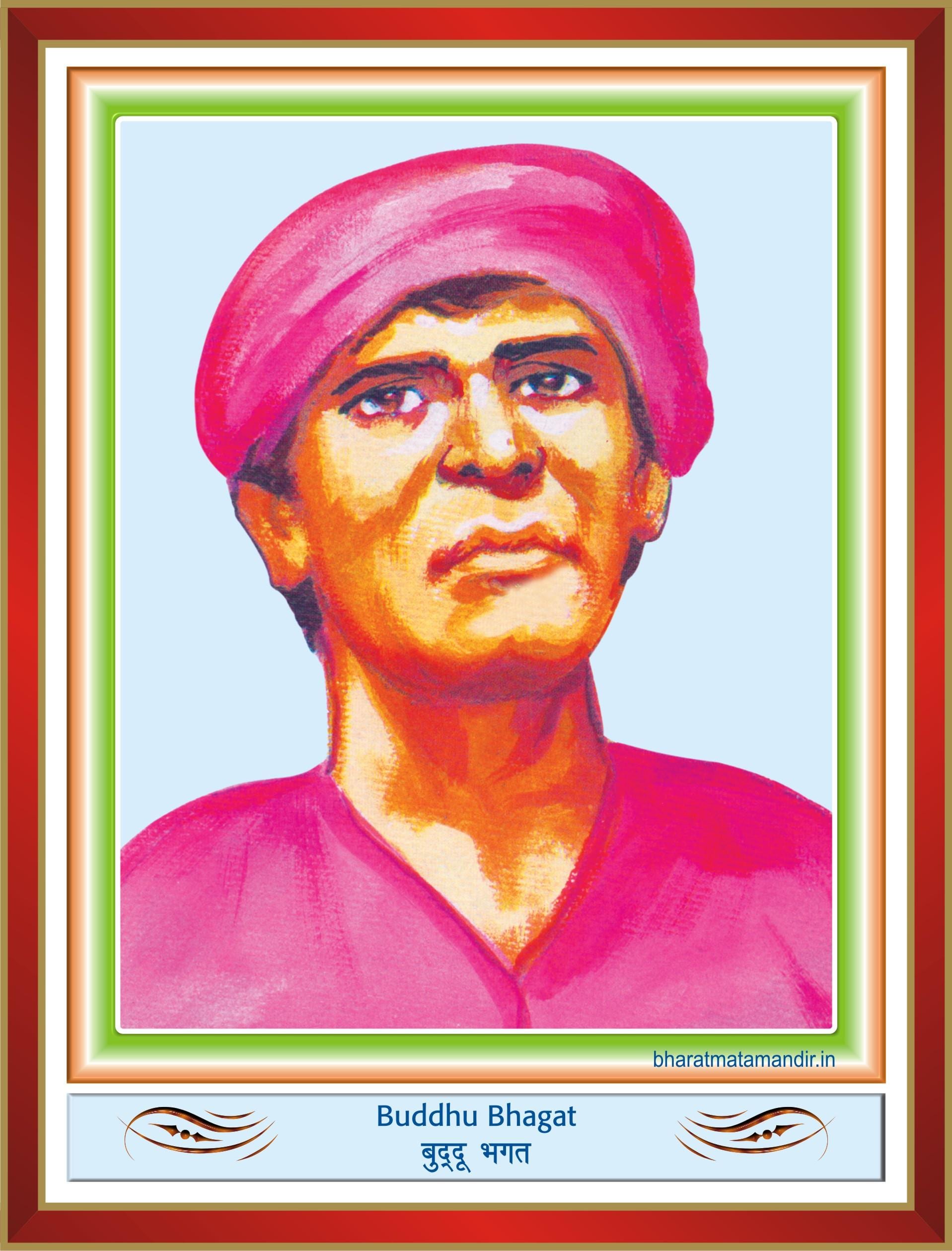
Budhu Bhagat, Tribal Leader, Freedom Fighter
Tribal Leader, Freedom Fighter

Budhu Bhagat

Born 17 February 1792 · Jharkhand — Died 13 February 1832

Led the Kol and Larka rebellions against British rule in Chhotanagpur during 1831-32.

Budhu Bhagat was an Indian rebel. He had led guerrilla warfare against British. He was leader of Kol rebellion and Larka rebellion in 1831-32 in Chhotanagpur.

✨

A detail that
surprised us

“

The British announced a reward for Budhu Bhagat’s capture, underscoring how much colonial authorities feared his leadership in 1832.

The Story

1
In 1831, Budhu Bhagat, born in 1792 in Silagai village, led a fierce Kol rebellion that spread across Ranchi, Hazaribagh, Palamu, and Manbhum, marking a major tribal uprising against British colonial rule in Chhotanagpur.
2
🔥 By 1832, Budhu Bhagat united Oraon, Munda, Bhumij, and Ho tribes to launch the Larka rebellion directly challenging both British authorities and oppressive zamindars in Jharkhand.
3The British government placed a bounty on Budhu Bhagat’s head, reflecting the threat he posed to colonial control in the region.
4On 13 February 1832, British forces attacked Silagai village but faced fierce resistance as Budhu Bhagat’s followers wielded bows, arrows, axes, and swords in guerrilla warfare.

🔍 One thing most people don't know

“

The Kol rebellion led by Budhu Bhagat in 1831 spread rapidly over four districts—Ranchi, Hazaribagh, Palamu, and Manbhum—showing the extensive tribal coordination against British rule.

📸 Through the Years

📷

No photos yet

Help preserve history — add a photo of this icon

🗓️ A Life in Moments

🕊️
Birth
Birth of Budhu Bhagat in Silagai
Budhu Bhagat was born into an Oraon farmer family in Silagai village, Chanho block, Ranchi district, British India.
1792
⚡
Career
Led Kol rebellion across four districts
Budhu Bhagat spearheaded the Kol rebellion, spreading resistance through Ranchi, Hazaribagh, Palamu, and Manbhum regions against British colonial rule.
1831
⚡
Career
Initiated Larka rebellion with tribal coalition
He united Oraon, Munda, Bhumij, and Ho tribes in the Larka rebellion against British and zamindar oppression in Chhotanagpur.
1832
⚡
Career
British attack on Silagai village
British forces attacked Silagai village to capture Budhu Bhagat but faced armed tribal resistance using traditional weapons.
1832
🕊️
Death
Death of Budhu Bhagat and sons
Budhu Bhagat was captured and killed by the British; his sons Haldhar and Giridhar died defending their village during the conflict.
1832
More moments to come...
+ Add a moment

🗝️Discoveries

Swipe to uncover hidden stories
01 / 04
💡SURPRISING

During the British attack on Silagai village on 13 February 1832, Budhu Bhagat’s followers used traditional weapons like bows, arrows, axes, and swords to fiercely resist modern British forces.

02 / 04
👤PERSONAL

Budhu Bhagat’s sons, Haldhar Bhagat and Giridhar Bhagat, died fighting alongside him during the British assault on Silagai in 1832.

03 / 04
🌍HISTORICAL IMPACT

The Larka rebellion of 1832 united multiple tribal groups—Oraon, Munda, Bhumij, Ho—under Budhu Bhagat’s leadership against both British colonial forces and exploitative zamindars.

No quote recorded for Budhu Bhagat yet.

🌱 What changed because of them

Budhu Bhagat’s leadership in the Kol and Larka rebellions galvanized tribal communities across Chhotanagpur to resist British and zamindar oppression, inspiring successive generations of tribal freedom fighters. His resistance influenced the formation of tribal identity politics and movements in Jharkhand, contributing to the eventual recognition of tribal rights and autonomy in the region. His legacy is commemorated in Jharkhand as a symbol of early anti-colonial struggle.

💬 Social Buzz

💬

What are people saying about Budhu Bhagat?

Share posts from historians, journalists and notable voices about this icon. 🇮🇳

💭 Memories & Tributes

Share your memory of Budhu Bhagat...
Loading memories...
Is this profile accurate?