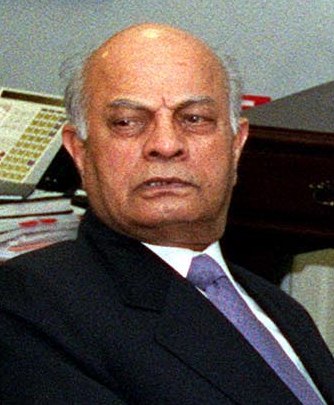
Brajesh Mishra, Diplomat, National Security Advisor
Diplomat, National Security Advisor

Brajesh Mishra

Born 29 September 1928 · Uttar Pradesh — Died 28 September 2012

Serving as India's first National Security Advisor from 1998 to 2004.

Brajesh Chandra Mishra was an Indian politician and diplomat from the Indian Foreign Service who is best known for serving as the first National Security Advisor of India from 1998 to 2004. He also served as the principal secretary of then Prime Minister Atal Bihari Vajpayee. He received the Padma Vibhushan for his contributions.

A detail that
surprised us

Mao Zedong personally greeted Brajesh Mishra with a handshake in 1970, signaling a rare thaw in Sino-Indian relations just eight years after their war.

The Story

1
In 1970, Brajesh Mishra stood in Beijing as Charge d’Affaires when Mao Zedong unexpectedly shook his hand at a May Day event, urging India and China to end their quarrels and become friends again, a rare diplomatic moment after the 1962 war.
2
🌏 From 1979 to 1981, Mishra was India’s Permanent Representative at the UN, where his quiet dissent against the Soviet invasion of Afghanistan clashed with government policy, leading to his resignation from the Indian Foreign Service and a shift to the United Nations.
3🚀 In 1998, the day Atal Bihari Vajpayee became Prime Minister, Mishra was appointed principal secretary and soon after oversaw India’s 1998 nuclear tests, accelerating India’s ascent as a nuclear power within weeks of the new government taking office.
4🕵️‍♂️ As the first National Security Advisor from 1998 to 2004, Mishra institutionalized India’s national security framework, creating the National Security Advisory Board alongside strategic minds like K. Subrahmanyam, reshaping how India managed security and foreign policy.

🏅 Awards & Honours

Padma Vibhushan

🔍 One thing most people don't know

In May 1970, at a May Day event in Beijing, Mao Zedong shook Brajesh Mishra’s hand and expressed a desire to restore friendship between China and India after the 1962 war, a rare public diplomatic gesture.

🖼️

Through the Years

5 photographs from the archives
Brajesh Mishra meets U.S. Secretary of Defense Donald H. Rumsfeld at the Pentagon (2001).
2001
Brajesh Mishra and Lalit Mansingh meet U.S. Deputy Secretary of Defense Paul Wolfowitz (2001).
Brajesh Mishra greets U.S. Secretary of State Colin Powell in New Delhi (2004).
Brajesh Mishra receives Russian Defence Minister Sergei Ivanov in New Delhi (2004).
Brajesh Mishra receives the Padma Vibhushan award from President Pratibha Patil in New Delhi (2011).

🗓️ A Life in Moments

🕊️
Birth
Born in Uttar Pradesh to Dwarka Prasad Mishra
Brajesh Chandra Mishra was born into a politically influential Brahmin family; his father was a former Chief Minister of Madhya Pradesh and a close aide to Indira Gandhi.
1928
Career
Joined Indian Foreign Service
Mishra began his diplomatic career entering the Indian Foreign Service, which shaped his future role in India’s foreign policy.
1951
Career
Mao Zedong shakes his hand in Beijing
At a May Day event in Beijing, Mao greeted Mishra in a rare diplomatic gesture signaling China's willingness to mend ties with India.
1970
Career
Permanent Representative to the UN
Mishra represented India at the United Nations and controversially voiced dissent on the Soviet invasion of Afghanistan.
1979
Career
Joins Bharatiya Janata Party
Mishra switched political allegiances joining BJP and headed its foreign policy cell, diverging from his father's Congress legacy.
1991
Career
Appointed Principal Secretary to PM Vajpayee
On the exact day Vajpayee became Prime Minister, Mishra was appointed principal secretary, soon becoming the most powerful bureaucrat in the PMO.
1998
Career
India conducts nuclear tests
Under Mishra’s watch, India executed nuclear tests signaling its arrival as a nuclear power and changing the geopolitical landscape.
1998
Career
Supports Bhutan’s Operation All Clear
Mishra played a crucial role in backing Bhutan’s military operation to expel militants, marking India’s strategic influence in the region.
2003
🕊️
Death
Death of Brajesh Mishra
Mishra passed away on the eve of his 84th birthday, closing the chapter on one of India’s most influential diplomatic and political careers.
2012
More moments to come...
+ Add a moment

🗝️Discoveries

Swipe to uncover hidden stories
01 / 05
🔍LESSER KNOWN

As India’s Permanent Representative to the UN (1979-1981), Mishra publicly voiced a position on the Soviet invasion of Afghanistan that conflicted with Indian government policy, prompting his resignation from the Indian Foreign Service.

02 / 05
🏆ACHIEVEMENT

Brajesh Mishra was the first non-IAS officer appointed as Principal Secretary to the Prime Minister, a post that grew so powerful under him it eclipsed many cabinet ministers.

03 / 05
🌍HISTORICAL IMPACT

Mishra was a key architect in supporting Bhutan’s 2003 Operation All Clear, which involved Bhutanese forces clearing militant groups from its territory with Indian backing.

No quote recorded for Brajesh Mishra yet.

🌱 What changed because of them

Brajesh Mishra transformed the role of the Principal Secretary to the Prime Minister into the most powerful bureaucratic position in India, overshadowing ministerial ranks. He established the institutional foundations for India's National Security Council and Advisory Board, which continue to guide India's strategic and nuclear policies. His behind-the-scenes role in the 1998 nuclear tests and diplomatic balancing act with China and the US reshaped India's foreign policy dynamics.

💬 Social Buzz

💬

What are people saying about Brajesh Mishra?

Share posts from historians, journalists and notable voices about this icon. 🇮🇳

💭 Memories & Tributes

Share your memory of Brajesh Mishra...
Loading memories...
Is this profile accurate?