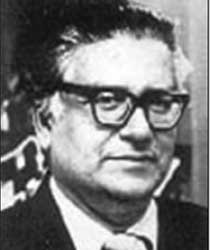
Bimal Kumar Bachhawat
Born 16 August 1925 · verify
Died 23 September 1996
Discovered HMG-CoA lyase, key in mevalonate and ketogenesis metabolic pathways.
🔔 Add birthday reminderBimal Kumar Bachhawat was an Indian neurochemist and glycobiologist, known for his discovery of HMG-CoA lyase, an intermediate in the mevalonate and ketogenesis pathway, and for the elucidation of the molecular cause of metachromatic leukodystrophy, a hereditary disease of the brain His studies on sugar-bearing liposomes led to its use as a carrier for in situ delivery of drugs and hormones to diseased organs and he pioneered the therapy of systemic fungal infections using liposomal formulations. He was a recipient of several awards including the Shanti Swarup Bhatnagar Award, the highest Indian honor in science and technology and an elected fellow of three major Indian science academies. The Government of India awarded him the third highest civilian honour of the Padma Bhushan, in 1990, for his contributions to science.
✨ A detail that surprised us
Bimal Kumar Bachhawat discovered HMG-CoA lyase, a key enzyme in ketogenesis, during his postdoctoral work in the US before returning to India to transform neurochemical research.
1. 🌍 Born in Kolkata on 26 August 1925, Bimal Kumar Bachhawat pursued his MSc in Applied Chemistry from the University of Calcutta by 1948, setting the stage for his future biochemical explorations.
2. 🎓 In 1953, he earned his PhD from the University of Illinois, Urbana–Champaign, after pioneering research on antibiotics under Carl Swensson Vestling, a period during which he also worked on ketone body formation in mammals at the University of Michigan.
3. 🔬 Returning to India in 1957, he established a neurochemistry and glycobiology research center at Christian Medical College, Vellore, where he began unraveling the molecular causes of rare brain diseases like metachromatic leukodystrophy.
4. In 1976, Bachhawat took charge as director of the Indian Institute of Chemical Biology in Kolkata, where he became the first Indian president of the Federation of Asian and Oceanian Biochemists (1983–1985), a post that connected him with leading Asian researchers.
5. 💊 His studies of sugar-bearing liposomes led to novel drug delivery techniques targeting diseased organs, including pioneering liposomal therapies for systemic fungal infections, marking a shift in targeted treatment modalities in India.
6. Awarded the Padma Bhushan in 1990, Bachhawat also received the Shanti Swarup Bhatnagar Prize and served as head of the Department of Biochemistry at the University of Delhi until his 1990 retirement, shaping interdisciplinary bioscience education.
7. ❓ How did Bachhawat’s dual focus on neurochemistry and glycobiology inspire the development of liposome-based therapies that are still relevant in modern drug delivery research?
Awards & Honours
- 🏅Shanti Swarup Bhatnagar Prize for Science and Technology
🔍 One thing most people don't know
In 1953, Bachhawat completed his PhD in biochemistry at the University of Illinois, Urbana–Champaign, where he worked on ketone body formation, linking metabolism to steroidogenesis before many of these pathways were fully understood.
🖼️ Through the Years
📷 No photos yet
📅 The Journey
🗝️ Discoveries
🎥 Speeches & Recordings
🎥 Know a speech or documentary about Bimal Kumar Bachhawat?
📖 Curated Sources
🌱 What changed because of them
Bachhawat’s fusion of neurochemistry with glycobiology established new understanding of hereditary brain diseases such as metachromatic leukodystrophy, influencing diagnostic and therapeutic approaches in India. His leadership roles at the Indian Institute of Chemical Biology and University of Delhi fostered research infrastructure and interdisciplinary bioscience programs, while his innovations in liposome drug delivery paved the way for targeted therapies in fungal infections and beyond.
💬 Social Buzz
🐦
What are people saying about Bimal Kumar Bachhawat?
Found a post from a historian, journalist or notable voice? Share it here and help tell their story. 🇮🇳